.png)
Q2 2026 Market Perspective

Three months into the new year, and we have already gone through so many events that continue to shape the world. The market has experienced a challenging quarter, with the Nasdaq entering correction territory in recent weeks. Investors remain cautious about the tech sector with concerns of an “AI bubble”, though discussions have been fading. Additionally, increased volatility and rising oil prices, byproducts of the Iran war, have added ever more fear among investors and raised concerns about how it could impact the economy. At a macro level, the economy remains solid despite concerns that higher oil prices could cause an inflationary shock to the economy. Of course, changes in CPI (Consumer Price Index) are expected in the coming months, but consumer spending is still trending upwards, and unemployment remains stable.

The biggest driver that could potentially disrupt the economy is the ongoing war between the US, Israel, and Iran. With all these series of events and unpredictable markets, we remain focused on staying disciplined and maintaining diversification by taking a defensive approach that will ultimately reward those who stay invested.
Inflation
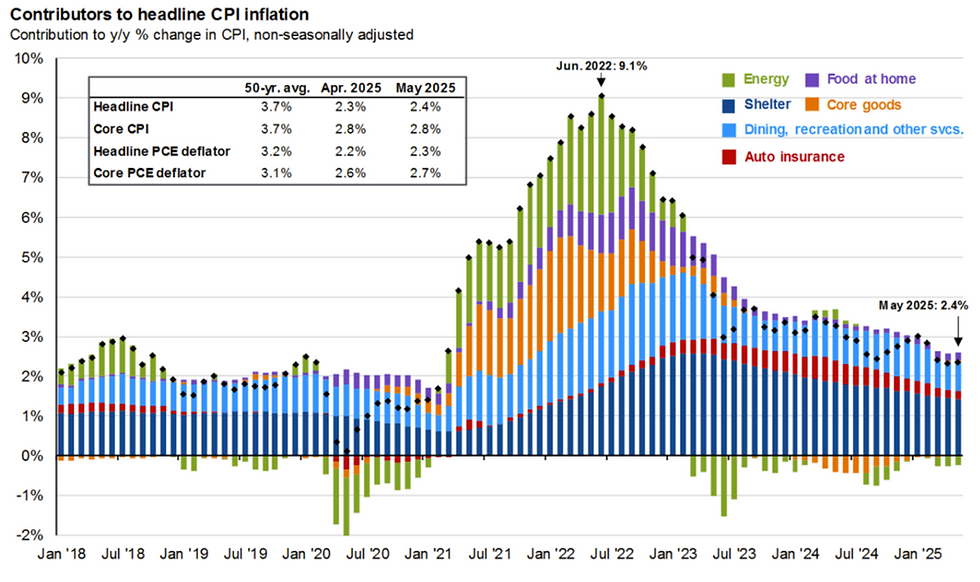
The Federal Reserve Bank remains focused on their 2% inflation goal, but most recently, during the FOMC (Federal Open Market Committee) March meeting, which was associated with economic projections, announced an upward change to the PCE (Personal Consumption Expenditures) and Core PCE forecast for the 2026 Year-End estimates, meaning they expect inflation to rise, given the current conditions. As of March, CPI (Consumer Price Index) rose to 3.3% YoY. As a result, the chances of a rate cut have diminished. On a brighter note, the labor force remains resilient. In March, the economy added 178k jobs, and the unemployment rate sits at 4.3%. The biggest challenge the Federal Reserve faces are the implications of the ongoing negotiations between the US and Iran; being actively at war poses even higher risks for future changes in monetary policy.
Interest Rates
At the beginning of the year, the Fed announced the possibility of a rate cut in 2026. As we already know, nothing is ever set in stone. The ever-changing economic landscape and current geopolitical tensions between the US, Israel, and Iran have thrown a curveball, making it more difficult to manage sticky inflation due to the oil price shock. Currently, the federal funds rate is 3.5%-3.75%, but market expectations are about 22 basis points higher than the FOMC year-end estimate.

The current political instability has raised concerns about the future of the economy and how it can diminish company growth across all sectors.
Market Overview
The US-Iran war has triggered significant volatility, and markets have shown a reactive pattern to the negotiations between countries. As of 3/31/2026, the S&P 500 was down -4.63% for the year. The supply shock has affected many countries globally. Suppliers and consumers alike have been affected by the closure of the Strait of Hormuz, where 20% of the world’s oil supply passes through. Even though the US is one of the largest producers, most oil isn’t exported; it is kept for our own consumption. However, because prices are set by global demand, it has become a concern for the US consumer. Some additional repercussions we may experience are increased costs in production and transportation across many industries, creating a ripple effect that could trigger higher costs for companies and consumers.

Despite it all, we remained steady. This is the nature of the market; such events are part of investing. Historically speaking, the S&P has averaged about 4.6 pullbacks of 5% each year in the last 36 years, yet over the long term, it has consistently delivered positive returns.
CWM Portfolios
Due to our investment strategies, we believe our client portfolios are well-positioned to tolerate market volatility spawned by different factors. This isn’t to say we aren’t reviewing any possible changes; in fact, we have considered increasing our international exposure to increase diversification, and because of the outperformance compared to US markets. Our international outlook is positive, and despite the current circumstances, US markets continue to be favorable across the world.

For investors with longer time horizons, market declines are usually seen as an opportunity to buy. As illustrated on this chart, the average subsequent S&P 500 return has been 24.1% following a trough in consumer market sentiment.
Corinthian is your partner when it comes to your finances, we are a resource when you have questions, and if you want to know how something will impact your financial situation, please contact your main advisor at (408) 995-0915.
Advisory services offered through Corinthian Wealth Management, Inc. a Registered Investment Advisor.
Sources
Dimensional Fund Advisors. (2026). Quarterly market review: First quarter 2026. https://my.dimensional.com/quarterly-market-review
J.P. Morgan Asset Management. (2026). Guide to the markets. https://am.jpmorgan.com/us/en/asset-management/protected/adv/insights/market-insights/guide-to-the-markets/
Board of Governors of the Federal Reserve System. (2026, March 18). Summary of economic projections. https://www.federalreserve.gov/monetarypolicy/files/fomcprojtabl20260318.pdf
J.P. Morgan Asset Management. (2026, April 1). Can the Iran war disrupt AI chip production? https://am.jpmorgan.com/us/en/asset-management/protected/adv/insights/market-insights/market-updates/on-the-minds-of-investors/can-the-iran-war-disrupt-ai-chip-production/
The Wall Street Journal. (2026, April 6). The Iran war is making the American economy more dominant than ever. https://www.wsj.com/economy/the-iran-war-is-making-the-american-economy-more-dominant-than-ever-287f9569
Vanguard. (2026, March 11). The potential impact of high oil prices on economies. https://advisors.vanguard.com/insights/article/the-potential-impact-of-high-oil-prices-on-economies
Trading Economics. (n.d.). United States inflation rate. https://tradingeconomics.com/united-states/inflation-cpi


Comments